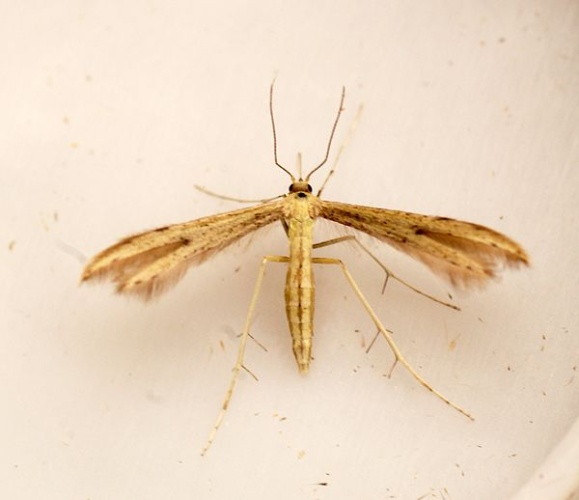
Adaina microdactyla
- <p>13th July 2013: Broxbourne Wood, Hertfordshire
</p>
<p><br>
13th July 2013: Broxbourne Wood, Hertfordshire
</p>
<p>I am not sure if it was the phenomenally hot day on Saturday, with temperatures reaching 30 degrees Celsius, or the fact that this trip was to one of the county hot-spots for all things ecological, but we did have a staggering 27 people turn up for the Herts Moth Group trip to Broxbourne Wood National Nature Reserve on 13th July 2013. The West Car Park was completely filled; at one point a police car nosed in, looked, probably thought we were a bunch of weirdos and immediately drove off having turned on his blue lights! In addition to myself, five other people had brought traps and so, as darkness approached, we made use of the fact that the wood has a long and straight ride up the middle; traps were loaded into my Landrover and dropped off at intervals along the ride where they were set up by their owners. In all we ended up with 10 lights here, stretched over a linear distance of 700 metres but, of course, dipping into the sides and various clearings. I confess that I was rather lazy and only one of these (the furthest from the car park) was mine, but as it turned out we really did not need the other five I had in the vehicle. Once these lights were fired up, I also set up a sheet on the side of the Landrover in the West Car Park. People were then free to wander along the trap line and/or stay at the sheet and see what came in.
</p>
<p>Almost immediately, the moths started coming and they were still coming as the last four of us packed up the last trap at just after 3 am (most people having left in stages between midnight and about 2 am). I am pretty sure that if we had stayed another hour until daybreak we could easily have added a dozen or more further species to the list, but as it is we had to make do with a total of 208 moth species! Very recently, I was moaning that “hundred nights” were a thing of the past (and of course, when moth-ers talk of “hundred nights” they mean 100 macros). Well … our macro total on Saturday night was 116 species. The astute will realise that this means we had 92 species of micro, but to my knowledge there are at least 3 further species awaiting dissection and it is possible that when this list appears that someone will e-mail me with others that I have overlooked.
</p>
<p>There are some rather “good” moths for Hertfordshire in the list – use the Herts Moth Book (or if you are under 50, the web site) to look them up. In number order, I might perhaps suggest you look up, amongst others, 397: Glyphipterix thrasonella (rare in the county); 1088: Pseudosciaphila branderiana (very local); 1449: Elegia similella (nationally scarce); 1494: Capperia britanniodactyla (last recorded in the county at this site); 1771a: Thera cupressata Cypress Carpet (recent colonist – first county record was in 2006); 1943: Hypomecis roboraria Great Oak Beauty (extremely local – we had several in the traps and at the sheet); 2039: Atolmis rubricollis Red-necked Footman (almost certainly part of the recent immigration – we had 6). Two species, in the form of 0926: Phalonidia manniana and 1375: Ostrinia nubilalis have recently been split into two species each – we have retained specimens but not yet looked at these critically. It was good to have both Aethes cnicana and Aethes rubigana so they could be compared and there were other species pairs too, which made the evening informative as well as fun (e.g., Clouded Brindle and Clouded Bordered-brindle). Happily, the numbers of individuals of each species appear to have resumed a near normal setting, although there were singles of just a few species. There were several Satin Beauties, mostly in my trap at the far end of the line and at the end of the session around 2.30 am. Here too, I am told by others, Violet Ground Beetles (Carabus violaceus) were making off with large numbers of Leopard Moths that had not made it all the way to the safety of the trap! Good numbers of Great Oak Beauty emphasise the nature of the woodland habitat at Broxbourne.
</p>
<p>Those marked with an asterisk (*) have been named by genitalia dissection. Thanks to all the trap operators who gave me lists of moths from their traps throughout the course of the evening. Please tell me if I missed anything.
</p>
<p>C.W.Plant
</p>
<p>Below I have listed the species that were present in my traps.
As the group was spread out, my traps got different species to what the others got, the best species by far were 2 scarce Map-winged Swifts that came to the Actinic.
Also the rare micros wee very pleasing to see in my traps.
</p>
<p><br>
12/07/13 – Broxbourne Woods - 1x 125w MV Robinson Trap, 1x 160w MBT Trap & 1x 80w Actinic Trap run from 9.45pm until 3.00am
</p>
<p><br>
Ghost Moth
Map-winged Swift
Tischeria ekebladella
Leopard Moth
Caloptilia alchimiella
Argyresthia goedartella
Scythropia crataegella
</p>
<p><br>
Yponomeuta evonymella
Paraswammerdamia nebulella [NEW!]
Cedestis gysseleniella [NEW!]
Prays fraxinella
Plutella xylostella
</p>
<pre>Ypsolopha ustella
</pre>
<p>Coleophora flavipennella
Batia unitella
Carcina quercana
Pseudatemelia flavifrontella [NEW!]
Parachronistis albiceps [NEW!]
Teleiodes vulgella
Teleiodes luculella
Blastodacna hellerella
Phalonidia manniana
Agapeta hamana
Aethes cnicana
Cochylis atricapitana
Pandemis cerasana
</p>
<pre>Pandemis heparana
Archips podana
Archips xylosteana
Lozotaeniodes formosanus
Epagoge grotiana
Ditula angustiorana
</pre>
<p>Pseudargyrotoza conwagana
Cnephasia asseclana*
Aleimma loeflingiana
Tortrix viridana
Spatalistis bifasciana [NEW!]
Celypha lacunana
Hedya pruniana
Hedya nubiferana
Hedya salicella
Apotomis turbidana
Ancylis achatana
</p>
<pre>Zeiraphera isertana
</pre>
<p>Epiblema uddmanniana
Eucosma cana
Eucosma obumbratana
Spilonota ocellana
Rhyacionia pinivorana
Chrysoteuchia culmella
Crambus lathoniellus
Catoptria pinella
Dipleurina lacustrata
Eurrhypara hortulata
Perinephela lancealis
Udea prunalis
Udea olivalis
</p>
<pre>Endotricha flammealis
Phycita roborella
</pre>
<p>Ephestia parasitella
Capperia britanniodactyla [NEW!]
Pterophorus pentadactyla
Adaina microdactyla
Drinker
Pebble Hook-tip
Peach Blossom
Buff Arches
Figure of Eighty
Blotched Emerald
Common Emerald
Clay Triple-lines
Blood-vein
Least Carpet
Small Fan-footed Wave
Treble Brown Spot
Riband Wave
Silver-ground Carpet
Common Carpet
Barred Straw
Common Marbled Carpet
Barred Yellow
Blue-bordered Carpet
Grey Pine Carpet
</p>
<pre>July Highflyer
</pre>
<p>Small Rivulet
Foxglove Pug
Wormwood Pug
Currant Pug
Grey Pug
Green Pug
Double-striped Pug
Small White Wave
Small Yellow Wave
Clouded Border
Tawny-barred Angle
Brown Silver-line
Bordered Beauty
Lilac Beauty
Swallow-tailed Moth
Peppered Moth
Willow Beauty
Mottled Beauty
Satin Beauty [NEW!]
Great Oak Beauty
Pale Oak Beauty
Engrailed
Brindled White-spot
Bordered White
Common White Wave
Common Wave
Clouded Silver
Light Emerald
Barred Red
Poplar Hawk-moth
Elephant Hawk-moth
Buff-tip
Lobster Moth
Iron Prominent
Pebble Prominent
Maple Prominent
Pale Prominent
Yellow-tail
Rosy Footman
Red-necked Footman
Scarce Footman
Buff Footman
Common Footman
Buff Ermine
Short-cloaked Moth
Heart and Club
Flame
Flame Shoulder
Large Yellow Underwing
Ingrailed Clay
Double Square-spot
Smoky Wainscot
Minor Shoulder-knot
Poplar Grey
Miller
Grey Dagger
Bird's Wing
Small Angle Shades
Dark Arches
Light Arches
Clouded-bordered Brindle
Clouded Brindle
Dusky Brocade
Rufous Minor*
Tawny Marbled Minor
Small Dotted Buff
Uncertain
Marbled White Spot
Scarce Silver-lines
Oak Nycteoline
Burnished Brass
Beautiful Golden Y
Spectacle
Beautiful Hook-tip
Straw Dot
Snout
Fan-foot
Small Fan-foot
</p>
© Ben Sale from UK
- CC BY 2.0
- Wikimedia Commons
_Adaina_microdactyla_(9294824352).jpg/600px-(1517)_Adaina_microdactyla_(9294824352).jpg)